
# Personal Safety & PPE: Complete Guide to Workplace Protective Equipment
Workplace safety is an essential part of every successful business. Across construction sites, manufacturing facilities, warehouses, factories, hospitals, laboratories and industrial operations, workers face different hazards every day.
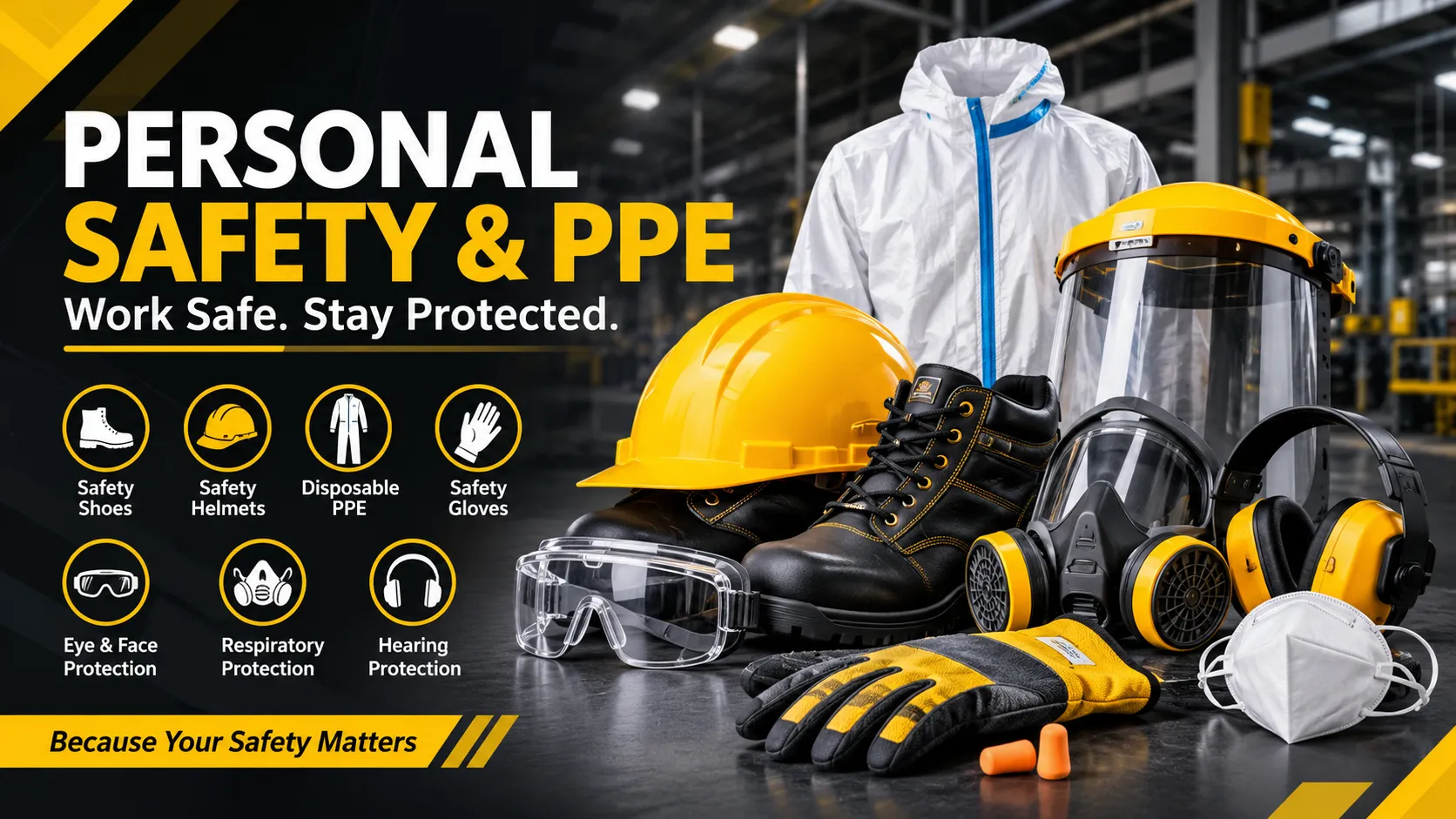
Personal Protective Equipment (PPE) plays an important role in protecting workers against workplace hazards. From safety shoes and helmets to protective gloves, disposable coveralls, safety goggles, respirators and hearing protection, the right equipment helps reduce exposure to potential workplace injuries and health risks.
At **VEZMARA**, we understand the importance of workplace protection. Our Personal Safety & PPE category brings together a wide range of protective equipment for individual customers, businesses, contractors, industrial buyers and safety professionals.
In this complete guide, we explore the major types of personal protective equipment, their applications, important selection considerations and how businesses can develop better workplace safety practices.
## What Is Personal Protective Equipment (PPE)?
Personal Protective Equipment, commonly known as PPE, refers to protective clothing, devices and equipment worn or used by workers to reduce exposure to workplace hazards.
Depending on the working environment, PPE can protect different parts of the body, including:
- Feet and legs - Head and face - Hands and arms - Eyes - Respiratory system - Ears and hearing
PPE is an important part of workplace risk management. However, it should be selected as part of a broader safety programme that includes hazard identification, engineering controls, safe working procedures and employee training.
## Why Is PPE Important in the Workplace?
Different industries expose workers to different types of hazards. Without suitable protective equipment, employees may face risks from falling objects, sharp materials, chemicals, dust, excessive noise, heat and other occupational hazards.
Appropriate PPE helps businesses:
- Reduce the risk of workplace injuries. - Protect employees from identified occupational hazards. - Improve workplace health and safety practices. - Support compliance with applicable safety regulations. - Create safer industrial and commercial environments. - Improve worker confidence and comfort. - Establish a stronger workplace safety culture.
Selecting the right equipment for each task is essential. Not every type of PPE provides protection against every workplace hazard.
## Types of Personal Safety & PPE Equipment
Personal protective equipment is available in different categories, each designed for specific workplace applications.
Let's explore the major PPE categories available at VEZMARA.
1. Safety Shoes
Safety shoes are designed to protect workers' feet against workplace hazards such as impact, compression, punctures, slipping and certain environmental conditions.
They are commonly used in construction, manufacturing, warehousing, logistics, engineering and industrial maintenance.
Common types of safety footwear include:
- Steel Toe Safety Shoes - Composite Toe Safety Shoes - Anti-Slip Safety Shoes - Electrical Hazard Safety Footwear - Anti-Static Safety Shoes - Heat-Resistant Safety Shoes - Safety Boots and Industrial Gumboots
When selecting safety footwear, consider the workplace hazards, toe protection requirements, sole construction, slip resistance, comfort, sizing and applicable safety standards.
For example, workers handling heavy materials may require impact-resistant toe protection, while employees working around certain electrical hazards may require footwear specifically designed and tested for that application.
Explore our [Safety Shoes](https://vezmara.com/category/personal-safety-ppe/safety-shoes) category for industrial and workplace protective footwear.
2. Safety Helmets
Safety helmets, also known as hard hats, are designed to protect workers' heads against specific workplace hazards.
They are widely used in construction, manufacturing, electrical maintenance, engineering, oil and gas and other industrial environments.
Common types include:
- Industrial Safety Helmets - Construction Hard Hats - Electrical Safety Helmets - Ventilated Safety Helmets - Helmet-Compatible Accessories - Safety Helmets with Visors
Important selection considerations include helmet type, impact protection, electrical classification where required, suspension system, chin strap compatibility and applicable standards.
A safety helmet should fit correctly and be inspected regularly for cracks, damage, deterioration and other signs that may affect its protective performance.
3. Disposable PPE
Disposable PPE includes single-use protective clothing and accessories designed for suitable hygiene, contamination-control and workplace protection applications.
These products are commonly used in healthcare facilities, food processing units, laboratories, cleaning services, pharmaceutical environments and industrial operations.
Common disposable PPE products include:
- Disposable Coveralls - Disposable Shoe Covers - Disposable Gloves - Disposable Face Masks - Bouffant Caps and Head Covers - Disposable Aprons - Beard Covers - Disposable Arm Sleeves
The appropriate product depends on the type of exposure, required protection level, material specifications and intended use.
For example, disposable coveralls may be selected for certain dust and splash protection applications, while disposable shoe covers can help support hygiene controls in designated areas.
Explore our [Disposable PPE](https://vezmara.com/category/personal-safety-ppe/disposable-ppe) category.
4. Safety Gloves
Safety gloves protect workers' hands against different occupational hazards, including cuts, abrasions, chemicals, heat, impact and electrical hazards.
The correct glove type depends on the material being handled, task requirements and potential exposure.
Common types of industrial safety gloves include:
- Cut-Resistant Gloves - Chemical-Resistant Gloves - Heat-Resistant Gloves - Electrical Insulating Gloves - Leather Work Gloves - Nitrile-Coated Gloves - Latex and Disposable Gloves - Anti-Vibration Gloves - Impact-Resistant Gloves
Different gloves provide different levels of protection. For example, cut-resistant gloves are designed for suitable sharp-material handling tasks, while chemical-resistant gloves must be selected according to the specific chemical and its compatibility with the glove material.
Electrical insulating gloves must be selected, tested and maintained according to their rated voltage and applicable requirements.
Before choosing safety gloves, consider grip, dexterity, material compatibility, sizing, durability and relevant standards.
Discover our [Safety Gloves](https://vezmara.com/category/personal-safety-ppe/safety-gloves) collection.
5. Eye & Face Protection
Eye and face protection equipment helps protect workers against hazards such as flying particles, dust, splashes, sparks, chemical exposure and certain forms of harmful radiation.
This equipment is important in construction, welding, grinding, manufacturing, laboratories and industrial maintenance.
Common eye and face protection products include:
- Safety Goggles - Protective Safety Glasses - Face Shields - Welding Protection Equipment - Chemical Splash Goggles - Visors and Face Protection Accessories
Different tasks require different protection levels.
For example, safety goggles may provide a closer protective fit against certain airborne particles and splashes, while face shields can provide additional face protection during suitable grinding and splash-related tasks.
A face shield should not automatically be considered a replacement for appropriate safety glasses or goggles when eye protection is required.
Select eye and face protection according to the specific hazard, visibility requirements, comfort and applicable safety standards.
6. Respiratory Protection
Respiratory protection equipment is designed to reduce exposure to harmful airborne contaminants when workplace hazards cannot be adequately controlled through other measures.
Workers may encounter dust, fumes, vapours, gases, smoke and other airborne hazards in different industrial environments.
Common respiratory protection products include:
- Disposable Dust Masks - N95 Respirators - Half-Face Respirators - Full-Face Respirators - Chemical Filter Cartridges - Gas Masks - Powered Air-Purifying Respirators (PAPR) - Respiratory Protection Accessories
The selection of respiratory protection requires careful consideration of the airborne hazard, concentration, oxygen conditions, required protection factor and equipment compatibility.
Respirator selection should be based on a proper workplace assessment. Where required, medical evaluation, fit testing, training and a formal respiratory protection programme should also be implemented.
Explore our [Respiratory Protection](https://vezmara.com/category/personal-safety-ppe/respiratory-protection) category.
7. Hearing Protection
Exposure to excessive workplace noise can damage hearing over time and may cause permanent hearing loss.
Hearing protection equipment helps reduce workers' exposure to hazardous noise levels when selected and used correctly.
Common hearing protection products include:
- Disposable Foam Earplugs - Reusable Earplugs - Corded Earplugs - Industrial Safety Earmuffs - Helmet-Mounted Earmuffs - Electronic Hearing Protectors - Banded Hearing Protectors
Hearing protection is commonly required in manufacturing facilities, construction sites, workshops, factories, mining operations and other noisy industrial environments.
When selecting hearing protection, consider noise levels, required attenuation, compatibility with other PPE, comfort and communication requirements.
Businesses should also assess workplace noise and implement suitable noise-control measures rather than relying exclusively on hearing protection.
Discover our [Hearing Protection](https://vezmara.com/category/personal-safety-ppe/hearing-protection) category.
## How to Choose the Right PPE for Your Workplace
Selecting the correct protective equipment requires understanding the workplace environment and the hazards employees may encounter.
Consider these important factors before purchasing PPE.
1. Identify Workplace Hazards
Start by assessing the work environment and identifying potential hazards.
These may include:
- Falling objects - Sharp materials - Chemical splashes - Excessive noise - Airborne dust and fumes - Heat and sparks - Slippery surfaces - Electrical hazards
A proper risk assessment helps determine which types of protection are necessary.
2. Select Equipment According to the Task
Different jobs require different protective equipment.
For example:
- Construction workers may require helmets, safety shoes, gloves and eye protection. - Welders may require suitable welding helmets, protective gloves and protective clothing. - Chemical-handling workers may require compatible gloves, goggles and respiratory protection. - Factory workers may require hearing protection, safety footwear and task-specific hand protection. - Warehouse employees may require safety shoes, gloves and high-visibility clothing.
PPE should always match the actual task and workplace hazards.
3. Check Safety Standards and Certifications
Before purchasing protective equipment, review the relevant product documentation, testing information and applicable safety standards.
Some commonly encountered PPE standards include:
- EN ISO 20345 for safety footwear. - EN 397 for industrial protective helmets. - EN 388 for protective gloves against mechanical risks. - EN 374 for protective gloves against chemicals and microorganisms. - EN 166 for personal eye protection. - EN 149 for filtering half masks. - EN 352 for hearing protectors.
Always verify the applicable edition, product marking and certification documentation. Not every product is designed to meet every standard.
4. Ensure Proper Fit and Comfort
Protective equipment must fit the worker correctly.
Incorrect sizing, poor adjustment or uncomfortable equipment can affect its proper use and protective performance.
Consider product sizing, adjustability, weight, ventilation, visibility and compatibility with other PPE.
5. Inspect and Maintain PPE
Protective equipment should be inspected before use and maintained according to manufacturer instructions.
Businesses should establish inspection procedures and replace damaged, expired or unsuitable equipment.
Disposable PPE should be replaced according to its intended single-use application and manufacturer instructions.
6. Train Employees
Employees should understand:
- Why particular PPE is required. - How to wear and adjust it correctly. - Its limitations. - How to inspect it. - When it must be replaced. - How to store and maintain it.
Proper training helps workers use protective equipment more effectively.
## PPE Requirements Across Different Industries
Different industries require different combinations of protective equipment depending on their operations.
Construction Industry
Construction workers may encounter falling objects, sharp materials, dust, noise, slippery surfaces and other hazards.
Common PPE includes safety helmets, safety shoes, protective gloves, eye protection, hearing protection and suitable respiratory protection.
Manufacturing Industry
Manufacturing facilities may involve machinery, moving components, chemicals, noise, heat and material-handling activities.
Depending on the task, workers may require protective footwear, safety gloves, safety glasses, respirators, helmets and hearing protection.
Oil & Gas Industry
Oil and gas operations can involve chemical exposure, hazardous atmospheres, high noise levels, mechanical hazards and electrical risks.
Suitable PPE may include flame-resistant clothing, safety footwear, chemical-compatible gloves, eye protection, respiratory protection and hearing protectors.
Warehousing & Logistics
Warehouse workers may encounter material-handling hazards, moving equipment, falling objects and vehicle traffic.
Common PPE includes safety shoes, protective gloves, high-visibility clothing and safety helmets where required.
Healthcare & Laboratories
Healthcare and laboratory environments may require specific hygiene and contamination-control measures.
Disposable gloves, protective masks, goggles, face shields, protective gowns and suitable respiratory protection may be required depending on the exposure risk.
## Common PPE Selection Mistakes to Avoid
Choosing unsuitable protective equipment can reduce the effectiveness of workplace safety measures.
Businesses should avoid these common mistakes:
1. Selecting PPE without conducting a workplace hazard assessment. 2. Purchasing equipment without checking its intended application. 3. Ignoring sizing and fitting requirements. 4. Using incompatible protective equipment together. 5. Continuing to use damaged or deteriorated PPE. 6. Ignoring manufacturer instructions. 7. Failing to train employees. 8. Treating PPE as a substitute for workplace hazard controls.
A well-planned PPE programme should combine suitable equipment, employee training, regular inspections and effective safety management.
## Why Choose VEZMARA for Personal Safety & PPE Equipment?
VEZMARA focuses on industrial safety and workplace protection equipment for individual customers, businesses, contractors and organizations.
Our Personal Safety & PPE category brings together different protective equipment groups to help customers explore suitable solutions for their workplace requirements.
Whether you are looking for industrial safety shoes, protective helmets, disposable PPE, safety gloves, eye and face protection, respiratory equipment or hearing protection, you can explore our dedicated product categories.
We aim to make workplace safety equipment easier to discover for both individual buyers and businesses looking for wholesale or bulk supply.
**Explore Personal Safety & PPE at VEZMARA:**
https://vezmara.com/category/personal-safety-ppe
## Frequently Asked Questions (FAQs)
What does PPE stand for?
PPE stands for Personal Protective Equipment. It includes protective clothing and devices designed to reduce workers' exposure to workplace hazards.
What are the main types of PPE?
The main PPE categories include safety footwear, safety helmets, disposable protective equipment, safety gloves, eye and face protection, respiratory protection and hearing protection.
Why is PPE important in industrial workplaces?
PPE helps reduce workers' exposure to workplace hazards and supports safer working environments when selected and used correctly as part of a comprehensive safety programme.
Which PPE is commonly used in construction?
Construction workers commonly use safety helmets, protective footwear, safety gloves, eye protection, hearing protection, high-visibility clothing and suitable respiratory protection depending on their tasks.
What is the difference between safety glasses and safety goggles?
Safety glasses generally provide protective coverage around the eyes, while goggles are designed to provide a closer fit around the eyes. The appropriate choice depends on the specific workplace hazard.
How do I choose the right safety gloves?
Consider the materials being handled, potential cuts, chemicals, heat, impact, electrical hazards, grip requirements and relevant glove standards.
What is respiratory protection equipment?
Respiratory protection equipment includes devices such as disposable respirators, half-face masks, full-face respirators and powered air-purifying respirators designed for suitable airborne hazards.
How often should PPE be replaced?
Replacement depends on the equipment type, manufacturer instructions, usage conditions, inspection results and applicable requirements. Damaged or unsuitable equipment should be removed from service.
Where can I buy Personal Safety & PPE equipment in Pakistan?
You can explore VEZMARA's Personal Safety & PPE category to discover workplace protective equipment for individual, commercial, industrial and wholesale requirements.
## Conclusion
Personal Protective Equipment is an important part of creating safer workplaces across construction, manufacturing, logistics, healthcare and industrial operations.
From safety shoes and helmets to protective gloves, disposable PPE, eye and face protection, respirators and hearing protection, every category serves a specific purpose in reducing workplace risks.
Businesses should identify hazards, select appropriate equipment, verify product suitability, train employees and establish regular inspection procedures.
Whether you are purchasing PPE for an individual worker, a construction project, a manufacturing facility or an entire workforce, choosing suitable protective equipment is an important investment in workplace safety.
Explore the complete range of [Personal Safety & PPE Equipment at VEZMARA](https://vezmara.com/category/personal-safety-ppe).
**VEZMARA — Protect Every Worker, Every Shift.**
*Safety Disclaimer: This article is for general educational purposes only. PPE selection should be based on workplace risk assessments, applicable regulations, product specifications and manufacturer instructions. No single PPE product provides protection against every workplace hazard.*